
Galvanized pipes were once a common choice for residential plumbing in the United States because they offered a practical way to protect steel pipes from corrosion. The problem is that the zinc coating does not last forever. In many older American homes, decades of water exposure, mineral buildup, scratches, threaded connections, and changes in water chemistry can eventually leave the underlying steel vulnerable to rust.
That is why a galvanized plumbing system can appear perfectly normal from the outside while becoming heavily corroded on the inside.
For homeowners, the first warning signs are often surprisingly ordinary: weak water pressure, rusty-colored water, clogged faucet aerators, leaking threaded joints, or a sudden drop in flow from one fixture. By the time these symptoms become obvious, the inside of the pipe may already be significantly narrowed by rust and mineral deposits.
This article explains why galvanized pipes rust in old US homes, what the warning signs look like, how to decide between a small repair and a larger repiping project, and what homeowners should consider before spending money on a plumbing upgrade.
Quick conclusion: Galvanized pipes rust because their protective zinc coating gradually wears away or becomes damaged, exposing the steel beneath to water and oxygen. In an older home, the practical issue is not simply surface rust. Internal corrosion can reduce the effective water passage, contribute to leaks, and cause recurring water-quality and pressure problems.
What Are Galvanized Pipes?
Galvanized plumbing pipe is generally made from steel that has been coated with zinc. The zinc coating was intended to provide a protective barrier and to help protect the steel through a sacrificial corrosion process.
When the coating is intact, it can significantly slow corrosion. But galvanized pipe is not corrosion-proof.
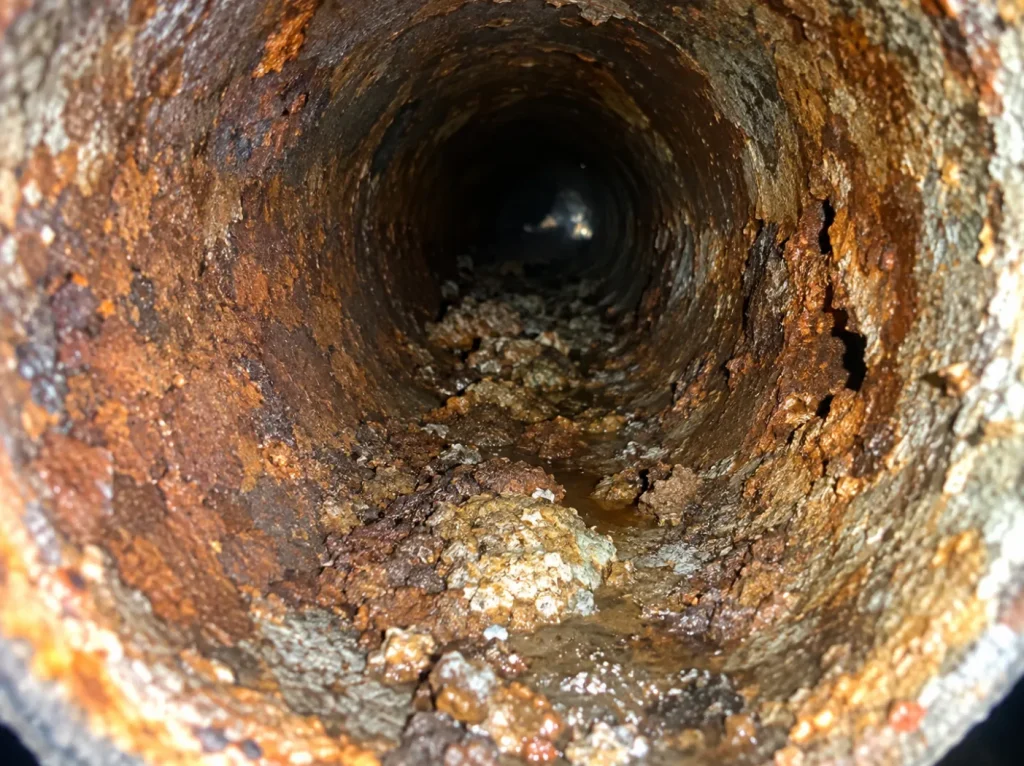
Over many years, the inner coating can become thinner, damaged, or consumed. Once the steel underneath is exposed, corrosion can begin. The resulting rust does not simply sit on the surface. It can form rough deposits inside the pipe, gradually reducing the space available for water to move through.
This is one reason an old galvanized system may still deliver water but perform poorly.
Why Do Galvanized Pipes Rust in Old US Homes?
1. The Zinc Coating Gradually Wears Away
The most basic reason is age.
Zinc provides protection, but it is gradually consumed during corrosion. In a plumbing system that has been in service for several decades, the original protective coating may no longer provide the same level of protection it did when the pipe was new.
Once enough of that protection is lost, the steel can begin corroding more aggressively.
This is especially important in older homes where the same galvanized plumbing may have remained in service for generations.
2. Water and Oxygen Drive the Corrosion Process
Steel reacts with water and oxygen. When the protective zinc layer is compromised, those conditions allow iron corrosion products to form.
The familiar result is rust.
Inside a pipe, however, rust behaves differently from a small spot of exterior surface rust. Corrosion products can create rough, uneven deposits that trap additional sediment and reduce the internal opening of the pipe.
That is why an old galvanized pipe can look physically large on the outside while providing a much smaller effective passage for water.
3. Water Chemistry Can Affect Corrosion
Not every home’s plumbing ages at exactly the same rate. Water chemistry can influence corrosion behavior, including factors such as acidity, alkalinity, dissolved minerals, temperature, and other water characteristics.
Two houses of a similar age can therefore have very different plumbing conditions.
This is also why a homeowner should avoid assuming that every galvanized system has the same remaining service life simply because the homes were built during the same decade.
4. Mineral Deposits Can Build Up Along With Rust
Corrosion is often only part of the problem. Minerals and sediment can accumulate on the rough interior surface of an aging pipe.
Instead of having a relatively smooth interior, the pipe may develop a combination of rust scale, mineral deposits, and debris.
The practical effect can be easy to notice at fixtures. A faucet that once produced a strong stream may gradually become weaker. Shower flow may decrease, and screens or aerators may repeatedly collect reddish or dark particles.
5. Threaded Joints Are Common Weak Points
Older galvanized plumbing systems often use threaded connections. These joints can become vulnerable as the surrounding metal corrodes over time.
A leak may therefore appear at an elbow, tee, valve connection, or other threaded fitting even when the straight section of pipe does not look particularly bad from the outside.
That creates a common repair dilemma: replacing one leaking fitting may solve today’s leak, but the rest of the nearby galvanized plumbing may already be approaching the same condition.
6. Contact With Other Metals Can Increase Corrosion Problems
Older plumbing systems are not always made from one single material. A house may contain galvanized steel, copper, brass, and newer plastic pipe sections.
When dissimilar metals are connected under the wrong conditions, galvanic corrosion can occur. The exact risk depends on the materials, water conditions, connection method, and plumbing design.
This is one reason a professional may pay close attention to transitions between galvanized steel and copper when investigating an old plumbing system.
What Does Rust Inside Galvanized Pipe Actually Do?
The biggest issue is that internal corrosion can become a flow problem before it becomes a visible leak.
Imagine a pipe that originally had a clean interior. Years later, corrosion creates a rough layer along the inside wall. Additional mineral deposits and sediment collect against that rough surface.
The opening becomes smaller.
Now the homeowner turns on a shower upstairs and notices weaker flow. A faucet on another branch may still work reasonably well. The problem can seem random even though the underlying cause is the same: the old plumbing system has lost usable internal capacity.
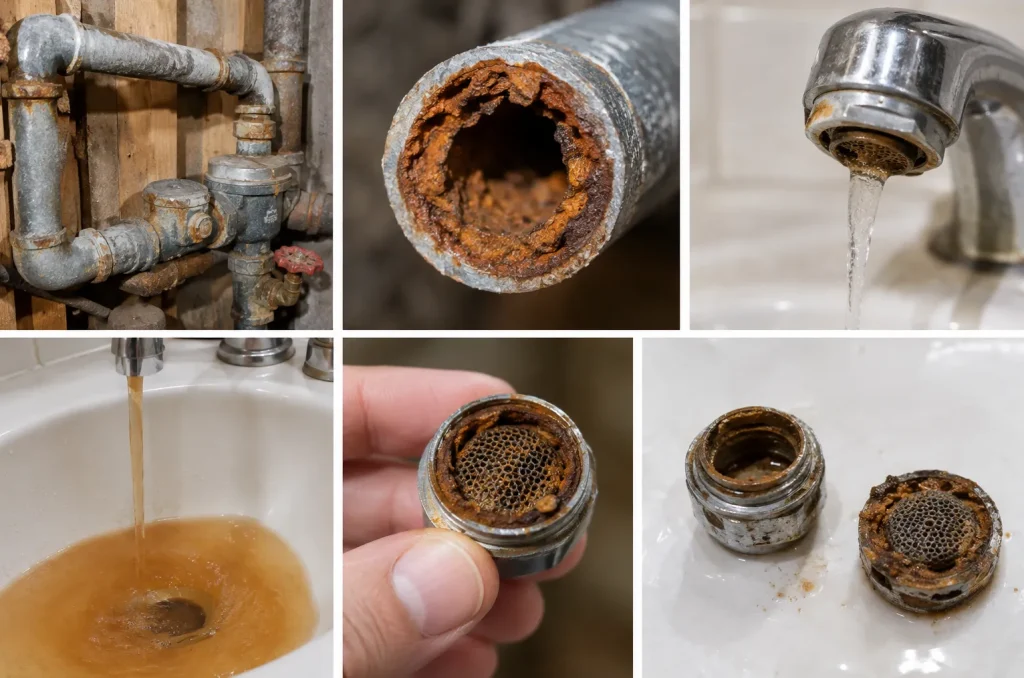
In severe cases, pieces of corrosion product can break loose and travel downstream. These particles may appear in faucet aerators, filters, showerheads, toilet fill valves, or other fixture components.
Common Warning Signs of Rusting Galvanized Pipes
- Brown, yellow, or reddish water: Rust particles may appear, especially after water has been sitting in the plumbing for a period of time.
- Low water pressure: Internal corrosion and deposits can restrict flow through old pipe sections.
- Weak shower flow: A noticeable reduction at the shower can be an early practical sign.
- Frequent faucet aerator clogging: Small rust particles and sediment can collect at fixture screens.
- Recurring leaks at threaded joints: Corrosion around old fittings can eventually create weak points.
- Visible rust staining: External staining around joints or fittings can indicate an aging or leaking section.
- Uneven pressure between fixtures: One room may perform normally while another has noticeably weaker flow.
One symptom alone does not prove that galvanized pipe is the cause. However, several of these problems occurring together in an older house should justify a closer plumbing inspection.
How Old Is Too Old for Galvanized Plumbing?
There is no single expiration date that applies to every galvanized plumbing system.
Condition depends on pipe quality, water chemistry, installation methods, maintenance, exposure, and how much internal corrosion has already occurred.
For practical planning, however, galvanized plumbing in a very old home deserves closer attention simply because age increases the chance that the protective coating and steel have experienced long-term corrosion.
A house with decades-old galvanized supply plumbing should not automatically be considered unsafe or unusable. The better question is: What condition is the system in today?
A professional inspection can help answer that question more reliably than the home’s construction date alone.
What a Plumber May Look For During an Inspection
A plumbing evaluation typically starts with symptoms and visible evidence rather than immediately replacing everything.
- Check exposed galvanized pipe for corrosion, staining, and damaged joints.
- Compare water flow at several fixtures.
- Look for repeated leaks or repairs in the same plumbing area.
- Inspect faucet aerators and filters for rust-colored sediment.
- Determine which parts of the house still use galvanized supply pipe.
- Check transitions between galvanized steel and other pipe materials.
- Assess whether the issue is isolated to one branch or appears throughout the house.
In some situations, a plumber may recommend opening a small section of pipe or using additional diagnostic methods to determine the internal condition.
That information matters because a local leak and a whole-house corrosion problem are two very different projects.
Repair One Section or Replace the Whole System?
This is usually the most important decision for a homeowner.
Replacing one damaged section is less disruptive and may make financial sense when the remaining plumbing is in reasonably good condition. A larger repipe can make more sense when multiple areas are already showing the same symptoms.
| Option | Typical situation | Installation | Maintenance | Main advantage | Main drawback |
| Repair a small section | One localized leak or damaged branch | Usually limited to a small area | Other old sections still need monitoring | Lower immediate cost and less disruption | May not solve system-wide aging |
| Replace several sections | Multiple recurring problems in one area | Moderate access and labor | Fewer aging sections remain | Balances cost and long-term improvement | Still leaves some old pipe in service |
| Whole-home repipe | Widespread corrosion, low flow, or frequent leaks | Larger project with more access work | New plumbing requires normal long-term maintenance | Creates a more consistent plumbing system | Higher cost, more disruption, and possible wall access |
How Much Does It Cost to Deal With Galvanized Pipes?
There is no reliable single price for the entire United States because plumbing labor, permits, access, house size, pipe layout, material choice, and local market conditions vary substantially.
For early planning, homeowners can think in broad categories rather than treating a number from the internet as a quotation.
| Project type | General planning level | What changes the final price |
| Small leak or short pipe section | Often hundreds to low thousands of dollars | Access, fittings, labor, emergency service, and wall or ceiling repair |
| Several pipe sections | Often a few thousand dollars | Number of fixtures, pipe routing, materials, and accessibility |
| Whole-home repipe | Often several thousand dollars and potentially well above $10,000 | House size, number of fixtures, material selected, crawlspace or slab access, permits, and finish repairs |
These are broad planning ranges, not current contractor quotes. In high-cost metropolitan areas or difficult-access homes, labor can increase the total substantially.
A useful homeowner strategy is to request an itemized estimate that separates plumbing labor, pipe materials, permits, wall or ceiling access, and finish repairs. That makes competing estimates easier to compare.
Which Replacement Material Is Commonly Considered?
When galvanized plumbing is removed, the replacement material depends on the local plumbing code, the home’s layout, project budget, installer experience, and the homeowner’s priorities.
| Material | General characteristics | Common considerations |
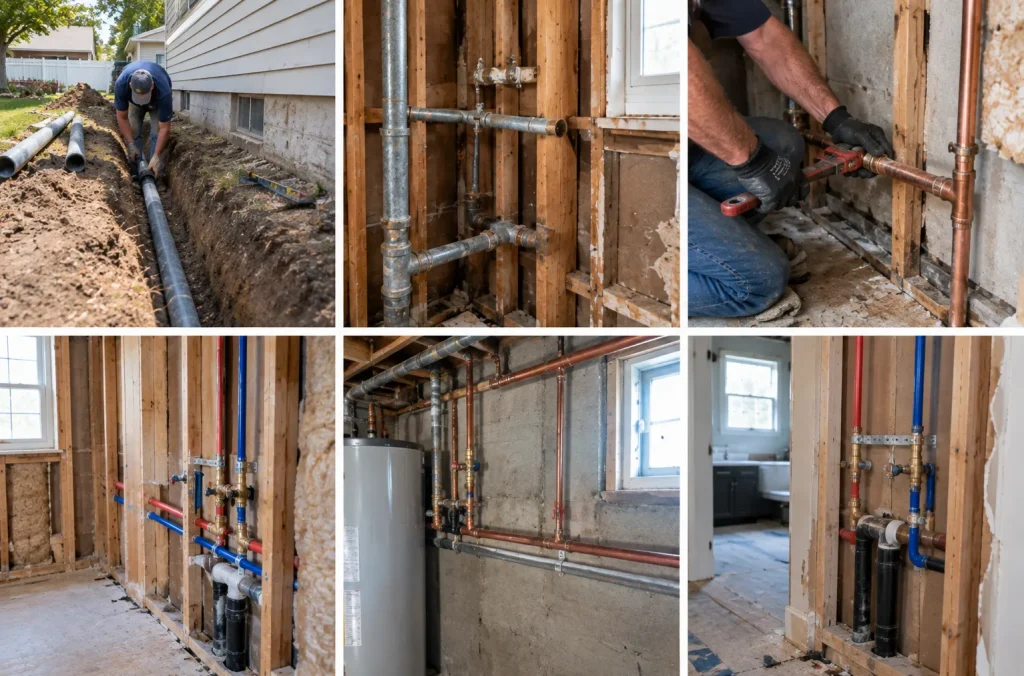
| PEX | Flexible plastic plumbing with relatively easy routing | Can reduce the number of fittings and may be practical where access is difficult; local code and installation requirements still apply |
| Copper | Traditional rigid plumbing material with long residential use | Durable and familiar to many plumbers, but material and labor costs can be higher than some alternatives |
| CPVC | Rigid plastic piping used in some residential systems | Suitability depends on code, existing system, installation conditions, and local practice |
The right replacement is not simply the material with the lowest price. Access, water conditions, local code, expected service life, noise, future repairs, and installation quality can matter just as much.
Real-World Scenario: When a Small Repair Makes Sense
Consider an older two-story home where a single galvanized elbow under the kitchen sink develops a leak. The rest of the home’s water flow is good, there are no recurring leaks, and inspection does not show obvious widespread corrosion.
In that situation, a localized repair may be a reasonable approach.
The key is to inspect the surrounding pipe rather than replacing only the visibly leaking fitting without considering its condition.
Old threaded galvanized connections can be fragile. Disturbing one connection can sometimes reveal that nearby components are also heavily corroded.
Real-World Scenario: When a Bigger Repiping Project Deserves Attention
Now consider a different house. The home has several decades-old galvanized supply lines. The shower has weak flow, multiple faucets repeatedly collect reddish sediment, and leaks have already occurred at more than one location.
In that situation, repeatedly repairing individual leaks may become a cycle.
A whole-home repipe or a phased replacement plan may deserve serious consideration because the symptoms suggest a system-wide aging problem rather than one isolated failure.
What Homeowners Should Check Before Paying for a Repipe
- Find out exactly which pipes are galvanized. Some homes contain a mixture of galvanized steel, copper, and plastic.
- Ask whether the problem is local or widespread. One leaking pipe does not automatically mean the entire system requires replacement.
- Compare water flow at several fixtures. System-wide flow problems provide more useful information than one weak faucet.
- Ask what access work is included. Cutting and repairing drywall, ceilings, or cabinets can change the final project cost significantly.
- Get material and labor details in writing. Two quotes may look similar while including very different scopes of work.
Common Mistakes Homeowners Make With Rusting Galvanized Pipes
Mistake 1: Treating Brown Water as Only a Cosmetic Problem
Discolored water can have multiple causes, but when it occurs together with an old galvanized system, internal corrosion deserves investigation.
Simply flushing the line may improve the appearance temporarily without addressing the underlying pipe condition.
Mistake 2: Replacing Only the Pipe That Finally Leaked
A leak can be the first visible failure in an older system rather than the only problem.
When a pipe breaks after many years of service, it is worth asking whether nearby galvanized sections show the same age and corrosion pattern.
Mistake 3: Assuming New Fixtures Will Fix Old Supply Pipes
Installing a new faucet or showerhead cannot restore internal diameter that has already been lost inside a heavily corroded supply pipe.
Sometimes cleaning a fixture solves a local restriction. Other times, the supply pipe is the real bottleneck.
Mistake 4: Ignoring Access and Finish Repair in the Budget
Plumbing is only part of the job in an older house. Depending on routing, a repipe may require access through walls, ceilings, cabinets, flooring, crawlspaces, or other finished areas.
Homeowners should ask about restoration work before comparing estimates.
Practical Tips for Living With Galvanized Plumbing While Planning Repairs
- Monitor water pressure and flow from multiple fixtures rather than relying on one faucet.
- Inspect visible joints periodically for staining, dampness, or active leaks.
- Clean faucet aerators and shower screens when sediment begins appearing.
- Pay attention to recurring discoloration, especially after water has been sitting in the plumbing.
- Keep records of repaired sections so you know which parts of the plumbing system remain galvanized.
- When requesting a plumbing quote, provide the home’s approximate age and any history of previous pipe leaks or replacements.
One practical lesson with old-home plumbing is that repeated small repairs can become useful diagnostic information. If the same type of problem appears again and again in different parts of the house, the pattern itself is worth discussing with a plumber.We cover Old House Repair in more detail in our guide to Old House Repair, including what to look for and how to handle common problems.
How to Decide Based on Your Situation
| Your situation | What to investigate first | Reasonable next step to discuss with a plumber |
| One isolated leak and good water flow | Condition of nearby pipe and fittings | Localized repair and inspection of adjacent sections |
| Several leaks over a short period | Extent of corrosion throughout the supply system | Compare sectional replacement with a broader repipe |
| Low pressure at several fixtures | Internal restriction and pipe condition | Inspect galvanized supply lines before replacing fixtures unnecessarily |
| Rust-colored sediment at multiple fixtures | Source of corrosion and sediment | Evaluate old galvanized sections and the wider plumbing system |
| Major renovation already planned | Whether plumbing access is already available | Compare the cost of replacing aging galvanized lines while walls or cabinets are open |
FAQ: Galvanized Pipe Rust in Old US Homes
1. How long do galvanized pipes usually last in an old house?
There is no universal service-life number because corrosion rates vary with water chemistry, installation quality, pipe condition, and other factors. Many galvanized systems in older US homes have already been in service for several decades, so condition inspection is more useful than relying on age alone.
2. Is rust inside galvanized pipe dangerous?
Rust-colored water should not simply be ignored, but the significance depends on the source and the condition of the plumbing system. Corrosion can affect water appearance, flow, and pipe integrity. When persistent discoloration occurs, homeowners should identify the source rather than assuming it is harmless or assuming it automatically indicates a serious health hazard.
3. Can galvanized pipes be repaired instead of replaced?
Yes. A localized repair can make sense when the damage is limited and the surrounding system remains in acceptable condition. The challenge is determining whether the failed section is an isolated problem or one symptom of widespread corrosion.
4. Why is my water pressure getting worse in an old house?
Internal corrosion and mineral deposits can reduce the effective opening inside aging galvanized pipe. However, low pressure can also come from valves, fixtures, supply issues, or other plumbing restrictions, so the whole system should be considered.
5. Should I replace galvanized pipes when remodeling an old bathroom or kitchen?
It can be worth evaluating. Remodeling often provides easier access to walls, cabinets, and ceilings. If the galvanized plumbing is already showing age-related problems, completing necessary pipe replacement during planned renovation may reduce the need for future access work. The decision should be based on the actual condition and project scope.
Conclusion
Galvanized pipes in old US homes are prone to rust because their zinc coating gradually loses its protective ability, while decades of exposure to water and oxygen leave the underlying steel increasingly vulnerable to corrosion.
The most important issue is not simply seeing a little surface rust. Internal corrosion can create rough deposits, collect sediment, restrict water flow, contribute to recurring leaks, and reduce the reliability of an aging plumbing system.
For homeowners, the smartest way to approach the problem is to look at the entire pattern: the home’s age, water pressure, discoloration, recurring leaks, visible pipe condition, and how much galvanized plumbing is still in service.
A single damaged fitting may only need a local repair. A house with repeated leaks, widespread low flow, and heavy rust sediment may require a much broader conversation about repiping.
In an old home, the goal is not to replace plumbing simply because it is old. The goal is to understand its current condition, identify the real source of the problem, and choose a repair or replacement strategy that makes sense for the home’s layout, budget, and long-term plans.
