If you own an older home in the United States, there is a good chance that some of its original plumbing is still hidden behind walls, beneath floors, or under the basement. In many older houses, cast iron was used for drain, waste, and vent piping because it is strong, relatively durable, and effective at reducing plumbing noise.
The problem is that cast iron drain pipes do not last forever. Years of exposure to wastewater, internal corrosion, deposits, shifting soil, and repeated plumbing use can eventually weaken the pipe or restrict its interior diameter. Sometimes the first sign is a slow drain that keeps coming back. In other cases, homeowners notice sewage odors, damp spots in the basement, or a leak near an old drain stack.
Replacing every cast iron pipe in an older house is not always necessary. A properly inspected system may need only a localized repair, while severely corroded or repeatedly failing pipes may justify more extensive replacement. The challenge is figuring out which situation you have before spending money on the wrong solution.
This guide explains how to recognize failing cast iron drain pipes, how professionals investigate the problem, which repair options are available, and what homeowners should consider when budgeting for repair or replacement.
Quick Answer: When Should Old Cast Iron Drain Pipes Be Repaired or Replaced?
Old cast iron drain pipes should be inspected when they develop recurring clogs, persistent sewer odors, visible corrosion, wastewater leaks, unexplained dampness, or repeated backups affecting multiple fixtures.
A localized defect in an otherwise serviceable pipe may be suitable for a sectional repair. A drain camera inspection may reveal internal scale, cracks, joint problems, or other defects that help determine the next step. If deterioration is widespread, several sections are failing, or the pipe has lost its structural integrity, replacement may be more economical than repeated repairs.
As a rough planning guide, an accessible pipe section may cost substantially less to replace than a buried building drain or a whole-house system. Trenchless methods can reduce excavation in suitable situations, but they are not appropriate for every damaged pipe.
Important: A pipe’s age alone does not prove that replacement is necessary. Its condition, material, location, drainage performance, and inspection results matter more than a specific birthday.
1. What Are Cast Iron Drain Pipes?
Cast iron drain pipes are metal pipes used to carry wastewater away from toilets, sinks, showers, tubs, and other plumbing fixtures. They may also form part of the building’s main drain stack or connect the house plumbing to an underground sewer line.
In many US homes built before the widespread adoption of modern plastic drain piping, cast iron was commonly used for larger drain lines and vertical stacks. The exact materials in an older house depend on its construction date, location, and previous renovations. A system may contain cast iron alongside copper, ABS, PVC, or other materials.
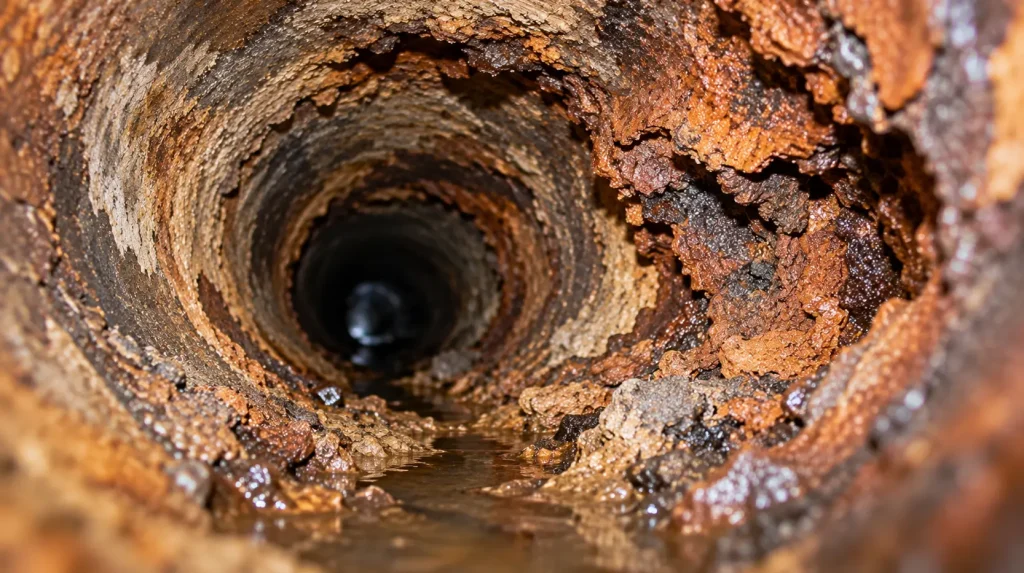
Cast iron is durable, but its inner surface can deteriorate over time. Corrosion products and scale may build up along the pipe walls, reducing the space available for wastewater to pass through. Underground sections can also be affected by soil movement, external corrosion, poorly supported joints, and tree-root intrusion at defective connections.
It is also important to distinguish drain piping from water-supply piping. Cast iron drain pipes carry wastewater; they are not the same as galvanized steel supply pipes that deliver water to faucets.
2. Warning Signs of Failing Cast Iron Drain Pipes
A failing drain system does not always show obvious damage. Some problems begin inside the pipe or beneath a floor, where they remain hidden until drainage performance deteriorates or water reaches the surrounding building materials.
Sign 1: Recurring Slow Drains
If a sink, tub, or shower keeps draining slowly even after the trap and accessible branch line have been checked, the problem may be farther downstream.
Corrosion and internal scale can create a rough surface that catches waste and other material. Over time, deposits may reduce the pipe’s effective diameter. However, slow drainage can also result from an ordinary blockage, a venting problem, or an obstruction elsewhere in the system. It is not proof that the cast iron pipe has failed.
Sign 2: Frequent Clogs or Multiple Fixtures Backing Up
A single clogged sink often points to a local problem. When several fixtures drain slowly at the same time, or using one fixture causes another to gurgle or back up, the issue may involve a shared branch drain, the main building drain, or the sewer line.
In an older home, repeated backups deserve more attention than a one-time clog. Before repeatedly using chemical drain cleaners or scheduling another simple clearing service, consider whether a camera inspection is appropriate.
Sign 3: Sewage Odors Inside the House
Persistent sewer smells near a basement floor drain, bathroom, or plumbing chase can indicate a dry trap, a damaged drain connection, a failed seal, or a venting issue. A cracked or leaking drain pipe is another possibility.
Do not assume that a smell automatically means the cast iron pipe itself is broken. A plumber should investigate the likely source, particularly when the odor continues after fixture traps have been checked.
Sign 4: Damp Spots, Water Stains, or Deteriorating Materials
A leaking drain pipe may leave damp concrete, stained drywall, swollen flooring, or damaged wood around the plumbing route. In basements and crawl spaces, look for persistent wet areas close to exposed drain lines and joints.
The source can be difficult to pinpoint because wastewater may travel along a pipe, joist, or subfloor before appearing on a different surface. A stain directly below a bathroom does not necessarily mean the leak is directly above it.
Sign 5: Visible Corrosion, Flaking, or Cracks
Exposed cast iron may show rust, rough surfaces, flaking, or deteriorated connections. Severe corrosion can eventually reduce the pipe wall’s strength. Cracks, displaced joints, or sections that are visibly deforming require closer assessment.
Do not aggressively scrape, hammer, or tighten a heavily corroded drain pipe to test whether it is still sound. A weakened section may be more fragile than it looks.
Sign 6: Repeated Sewer Problems Despite Previous Repairs
If the same drain keeps clogging or backing up after multiple cleaning visits, the underlying problem may not have been corrected. Internal scale, a damaged joint, a sagging section, root intrusion, or an improperly aligned replacement may require a different solution from routine drain cleaning.
A clear diagnosis can prevent you from paying repeatedly for short-term work that does not address the main cause.
3. How Long Do Cast Iron Drain Pipes Last?
Cast iron drain piping is often associated with a service life measured in decades. A commonly cited planning range is roughly 50 to 100 years, but this is not a guaranteed lifespan or a replacement deadline. Some systems deteriorate earlier, while others remain serviceable much longer.
The actual condition depends on several factors:
- Pipe environment: Soil conditions, moisture exposure, and external corrosion can affect buried sections.
- Wastewater and usage: The type of wastewater, maintenance history, and repeated exposure to certain chemicals may influence deterioration.
- Installation quality: Poorly supported pipes, defective joints, and inadequate slopes can create ongoing drainage problems.
- Internal deposits: Corrosion and scale can restrict flow even before the pipe develops a major leak.
- Previous repairs: Mixed materials and poorly executed connections can become weak points in an older system.
- Location and accessibility: Pipes concealed under slabs or inside finished walls may go unnoticed for longer, making small failures more expensive to investigate and repair.
For example, a house that still drains properly and has no evidence of leakage may not need immediate replacement simply because its cast iron pipes are old. On the other hand, a house with recurring backups, multiple leaking sections, and extensive internal corrosion deserves a more comprehensive evaluation.
4. How Plumbers Diagnose Problems Inside Cast Iron Drain Pipes
Before selecting a repair method, you need to know where the defect is, how extensive it is, and whether the pipe is still structurally suitable for service.
Drain Camera Inspection
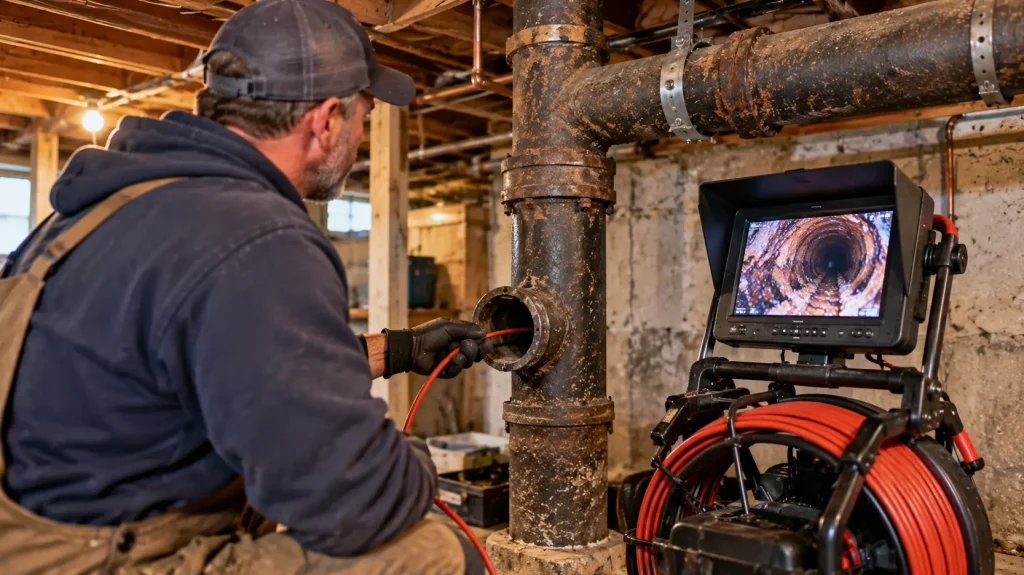
A plumber may insert a specialized waterproof camera through an accessible cleanout or another suitable access point. The camera can help identify internal scale, cracks, displaced joints, root intrusion, standing water, and other visible conditions.
Ask whether the camera can reach the suspected problem area and whether you will receive a recording or written findings. A camera inspection can be very useful, but it may not reveal every defect. Heavy deposits, standing water, difficult pipe geometry, and inaccessible sections can limit the view.
Checking the Accessible Piping
Exposed drain stacks and basement piping can be inspected for visible corrosion, leaking joints, damaged supports, and previous repairs. A plumber may also check cleanouts, traps, fixture drainage, and nearby connections to determine whether the problem is localized or affects a shared drain.
Evaluating Underground Drain Lines
If the suspected problem lies beneath a slab or in the yard, further investigation may be necessary. Depending on the situation, a plumber may recommend camera inspection, locating equipment, targeted excavation, or other diagnostic methods.
Do not assume a buried pipe needs to be dug up solely because the home is old. Locate the suspected defect and compare appropriate repair options before authorizing major excavation.
5. Repair Options for Old Cast Iron Drain Pipes
The right repair depends on the type of damage, the amount of sound pipe remaining, the location, and whether the line can be accessed safely.
Option A: Clear a Blockage and Remove Internal Deposits
If the pipe is structurally sound and the main problem is an obstruction or removable buildup, professional drain cleaning may restore flow. The cleaning method should match the pipe’s condition.
For severely corroded or fragile cast iron, aggressive cleaning methods can damage an already weakened section. Have the condition assessed before authorizing high-pressure water jetting or other intensive cleaning methods.
Drain cleaning restores flow in appropriate situations, but it does not rebuild a cracked pipe wall or permanently correct a defective joint.
Option B: Repair an Accessible Section
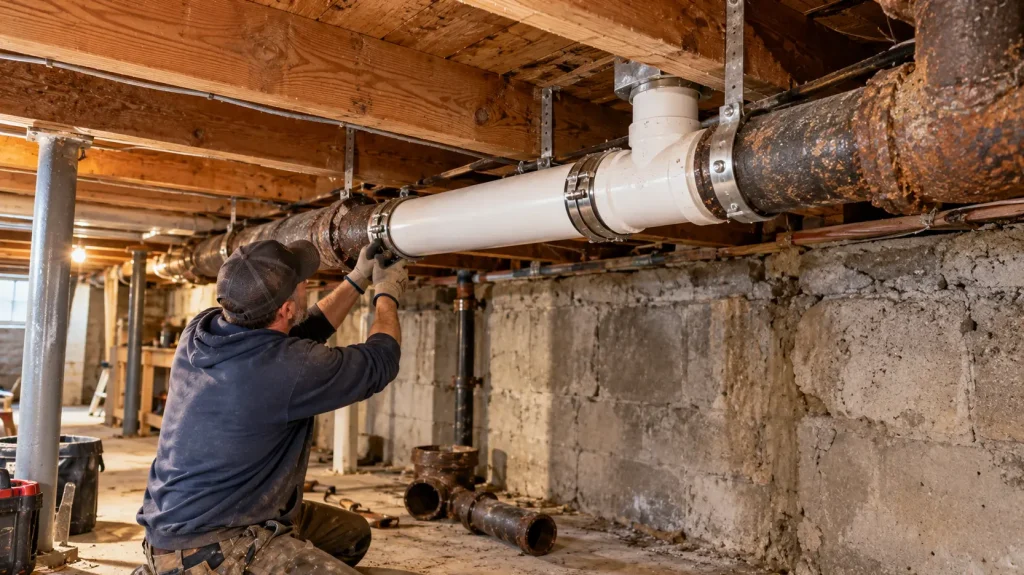
If damage is limited to a short, accessible section, a plumber may remove the affected pipe and install a compatible replacement segment with suitable approved connections and supports.
This approach can work well for exposed basement piping or a localized defect where the surrounding pipe remains in good condition. However, replacing one section does not automatically solve problems in other deteriorated sections.
Option C: Replace a Larger Section of Drain Piping
If corrosion or joint failure extends beyond one small area, replacing a larger section may offer better long-term value. For example, a plumber might recommend replacing an entire damaged branch line or a deteriorated portion of a vertical stack rather than making several small repairs.
More extensive replacement may require opening walls, ceilings, or floors, followed by restoration. Plan for those costs separately from the plumbing work itself.
Option D: Trenchless Pipe Lining
Some damaged drain or sewer pipes can be rehabilitated using a trenchless lining method. In suitable systems, a liner is installed inside the existing pipe and cured to form a new interior surface.
This can reduce the need for extensive excavation, but the existing pipe must be suitable for the selected method. Severe collapse, major displacement, incorrect slope, or other structural problems may make lining inappropriate or require preparatory work.
Ask the contractor to explain the liner’s intended coverage, preparation requirements, connection details, expected effect on the internal diameter, warranty, and any sections that will remain unrepaired.
Option E: Trenchless Pipe Bursting
Pipe bursting replaces an existing underground line by breaking or expanding the old pipe while pulling a replacement pipe into position. It may reduce the amount of surface excavation compared with a conventional open trench, depending on site conditions.
It is not suitable for every property. Access points, buried utilities, pipe alignment, soil conditions, and the condition of the existing line all matter. The contractor should explain where excavation is still required and whether nearby utility lines or structures could be affected.
Option F: Full or Partial System Replacement
If several sections show advanced deterioration, a more extensive replacement may be more practical than continuing to repair individual failures. This could mean replacing the underground building drain, the main stack, selected branch drains, or a much larger portion of the house’s drainage system.
Full replacement does not mean every pipe in the home must automatically be removed. The scope should be based on inspection findings, system layout, the condition of connected piping, and the owner’s long-term plans.
6. Old Cast Iron Drain Pipe Repair and Replacement Costs
Cost is often the biggest concern for homeowners. Unfortunately, there is no single price for replacing cast iron drain pipes in the United States. A short repair in an exposed basement can be much less expensive than replacing a sewer line beneath a concrete slab or a multi-story house’s concealed drain stack.
The following figures are broad, illustrative US planning ranges, not verified live quotations or guaranteed 2026 market prices. Local labor rates, pipe depth, accessibility, permit requirements, material choices, and restoration work can change the final bill substantially.
| Service or Repair | Illustrative Cost Range | Best Suited For | Main Advantages | Limitations |
|---|---|---|---|---|
| Drain camera inspection | $150–$500 | Investigating recurring clogs, suspected cracks, or underground drain problems | Helps locate defects before major work | Access and difficult pipe conditions may affect the inspection |
| Basic drain clearing | $150–$500 | A blockage in an otherwise serviceable line | May restore flow without pipe replacement | Does not repair structural damage |
| Localized repair on accessible piping | $300–$1,500 | A small damaged section in an accessible location | Limited demolition and a smaller repair scope | Nearby corrosion may lead to future failures |
| Replacement of a larger accessible section | $500–$2,500 | A deteriorated branch or exposed pipe section | Replaces the damaged material directly | Wall, ceiling, or floor restoration may cost extra |
| Trenchless pipe lining | Roughly $80–$250 per linear foot | A line that is suitable for lining after inspection and preparation | May reduce excavation and surface restoration | Not appropriate for every structural or alignment problem |
| Excavation and underground pipe replacement | Roughly $100–$300 per linear foot | A damaged buried line requiring direct replacement | Allows removal and replacement of the failed section | Digging, utilities, landscaping, and surface restoration can add costs |
| Extensive or whole-house drain replacement | Often $8,000–$30,000 or more | Widespread deterioration in a larger or difficult-to-access system | Can address multiple failing sections in one coordinated project | May involve major demolition, permits, and finish restoration |
These ranges are intended for early budgeting only. They are not directly interchangeable: a per-foot underground replacement price may exclude access pits, interior demolition, permits, disposal, landscaping, and repairs to concrete or finished surfaces. Whole-house projects can also fall outside the ranges shown.
What Factors Make Replacement More Expensive?
- Location: Pipes beneath a concrete slab or inside finished walls usually cost more to access than exposed basement piping.
- Pipe depth and length: Longer or deeper underground runs generally require more labor and excavation.
- Number of floors: Multi-story drain stacks may require access through several levels and more extensive finish restoration.
- Local labor and permits: Rates and code requirements vary by city, county, and state.
- Hidden damage: Wet drywall, damaged framing, contaminated materials, and flooring replacement can increase project costs.
- Access to the property: Tight crawl spaces, landscaping, driveways, and nearby utilities may complicate the work.
How to Compare Contractor Estimates
When comparing bids, ask each contractor to describe the same proposed scope of work. A low estimate may cover only the visibly damaged section, while a higher estimate may include camera inspection, access work, replacement of adjacent deteriorated piping, and restoration.
Request an itemized estimate showing diagnosis, pipe replacement or lining, permits, testing, cleanup, and the work excluded from the price. Also ask about warranties, required maintenance, and what happens if additional damage is discovered after work begins.
7. Should You Repair or Replace Your Cast Iron Drain Pipes?
There is no universal answer. The most practical choice depends on whether the damage is isolated, how much sound pipe remains, and how disruptive future repairs would be.
| Situation | Potentially Suitable Option | What to Confirm First |
|---|---|---|
| One accessible joint is leaking, and surrounding pipe is sound | Localized sectional repair | Condition of adjacent pipe and the replacement connection |
| A pipe drains slowly but has no confirmed structural damage | Inspection and appropriate cleaning | Whether buildup, a blockage, or a different defect is responsible |
| A buried line has a localized defect but remains suitable for rehabilitation | Sectional repair or a suitable trenchless method | Pipe alignment, structural condition, and method requirements |
| Several sections show significant corrosion and recurring leaks | Partial or more extensive replacement | Whether nearby branches and connected pipes also need attention |
| The underground pipe is collapsed or severely displaced | Direct replacement or another engineered solution | Extent of damage, access, soil conditions, and nearby utilities |
| You plan to renovate a bathroom or basement soon | Coordinate pipe work with the renovation | Which concealed lines should be inspected while surfaces are open |
Scenario A: An Older Home Has One Small Leak in an Exposed Basement Pipe
If the damaged portion is easy to reach and the surrounding pipe is in good condition, a localized repair may be reasonable. Have the plumber inspect the adjacent section and connections before treating the problem as an isolated failure.
Scenario B: The Main Drain Backs Up Every Few Months
Recurring backups deserve diagnosis rather than repeated clearing alone. A camera inspection can help determine whether the cause is internal scale, a damaged connection, tree-root intrusion, sagging pipe, or another obstruction. The best repair depends on what the inspection actually reveals.
Scenario C: You Are Remodeling an Older Bathroom
If the walls or floor will already be opened, it may be cost-effective to inspect accessible drain piping before the new finishes are installed. Replacing a known deteriorated section during renovation can avoid reopening the same area later, although replacement should still be based on evidence of condition and the intended scope of work.
Scenario D: The Sewer Line Runs Beneath the Concrete Slab
Do not assume that the entire slab must be removed. Ask about the available inspection methods and compare localized excavation, conventional replacement, and suitable trenchless options. The correct choice depends on pipe condition, access, alignment, and whether the line can support the selected repair method.
8. Mistakes to Avoid When Dealing With Old Cast Iron Drain Pipes
- Replacing pipes based on age alone: Use inspection results and observed performance to determine whether work is necessary.
- Repeatedly clearing the same blockage without investigating: Recurring clogs can indicate a deeper problem that routine cleaning does not solve.
- Using aggressive cleaning on fragile pipe: Have a professional assess severely corroded piping before selecting the cleaning method.
- Choosing trenchless repair without checking suitability: Liners and pipe-bursting systems have limitations and do not solve every type of damage.
- Ignoring connected pipe sections: A new piece of pipe may be attached to an older system that is already deteriorating.
- Comparing prices without comparing scope: Check whether estimates include inspection, permits, demolition, testing, and restoration.
- Ignoring the signs of wastewater leakage: Persistent sewage odors, damp materials, and backups should be investigated promptly.
Older homes may also contain hazardous materials in nearby finishes, insulation, or other building components. Before cutting into old walls or removing suspect materials, consider appropriate testing and safe work procedures.
9. How to Maintain Cast Iron Drain Pipes
You cannot stop every age-related failure, but good maintenance can help identify problems before they cause extensive damage.
- Investigate recurring slow drains rather than relying on repeated quick fixes.
- Avoid disposing of grease, wipes, and other unsuitable materials through plumbing fixtures.
- Inspect exposed basement piping periodically for drips, corrosion, and damaged supports.
- Pay attention to new sewer odors, unexplained dampness, and repeated backups.
- Ask a qualified plumber to recommend an inspection schedule based on the system’s actual condition.
- Keep records of camera inspections, repairs, and replacement materials so future contractors know what has already been done.
There is no single maintenance schedule that fits every cast iron system. A house with recurring defects may need closer monitoring than one whose drains perform normally and have no evidence of leakage.
10. Frequently Asked Questions
How do I know if my old cast iron drain pipes need replacing?
Warning signs include repeated blockages, multiple fixtures backing up, persistent sewer odors, visible pipe deterioration, leaking joints, and recurring moisture near drain lines. A drain camera inspection and examination of accessible piping can help determine whether the problem is isolated or widespread. Age alone does not establish that replacement is necessary.
How much does it cost to replace cast iron drain pipes in an old house?
Costs vary widely. Replacing a short, accessible section may cost hundreds to a few thousand dollars, while extensive underground work or whole-house replacement may cost many thousands or tens of thousands of dollars. Accessibility, pipe length, excavation, permits, local labor rates, and finish restoration are major cost factors. Obtain itemized local estimates before committing to the project.
Can old cast iron drain pipes be repaired instead of replaced?
Yes, when the damage is limited and the remaining pipe is suitable for continued service. Options may include cleaning, sectional replacement, or a suitable trenchless repair. If corrosion is extensive, the pipe has collapsed, or defects recur in multiple sections, broader replacement may offer better long-term value.
Are trenchless repairs suitable for every cast iron sewer pipe?
No. Trenchless lining and pipe bursting depend on the condition, alignment, location, and accessibility of the existing line. Severe collapse, major displacement, or other structural problems may require excavation or a different approach. Ask the contractor to explain the inspection findings and why the selected method suits your pipe.
How long can cast iron drain pipes last?
A frequently cited general planning range is roughly 50 to 100 years, but actual service life varies with installation quality, corrosion, soil conditions, maintenance, and use. Some pipes deteriorate earlier, while others remain functional longer. An inspection provides better information about the condition of a particular system than age alone.
Conclusion
Old cast iron drain pipes can remain serviceable for decades, but corrosion, internal scale, deteriorating joints, and structural damage can eventually lead to slow drains, recurring blockages, sewage odors, or leaks. Recognizing these warning signs early gives homeowners a better chance of choosing a practical repair before the problem becomes more disruptive.
Start by identifying the symptoms and arranging an appropriate inspection. A localized defect may need only a sectional repair, while widespread deterioration or a severely damaged underground line may justify partial or full replacement. Trenchless methods can be useful in suitable conditions, but no repair technique is right for every pipe.
Before approving major work, compare itemized estimates, confirm the scope of the repair, and ask how the contractor will verify the result. For an older home, the best investment is not automatically the cheapest repair or the largest replacement project. It is the solution that addresses the confirmed problem and provides a sound, maintainable drainage system for the years ahead.