
Common kitchen cabinet problems in older homes include sagging doors, loose hinges, sticking drawers, water-damaged cabinet boxes, peeling finishes, and warped wood panels. Many problems can be repaired by adjusting hardware, replacing damaged components, or correcting moisture sources. However, cabinets with extensive swelling, deteriorated particleboard, persistent mold, or weakened structural connections may need partial or complete replacement.
Introduction
Kitchen cabinets are among the most frequently used components in an older American home. Cabinet doors open dozens of times a day, drawers carry heavy cookware, and the area beneath the kitchen sink is regularly exposed to plumbing connections, cleaning products, and occasional moisture.
In homes built during the 1930s and 1940s, kitchen cabinets may be made from solid wood, plywood, or a combination of older materials and later replacement components. A 1950s kitchen may still have original wood cabinet boxes, while a 1970s or 1980s remodel may contain particleboard, laminate surfaces, or early generations of manufactured cabinet materials.
After decades of use, these cabinets can develop problems that are not always obvious at first. A door that no longer closes properly may have a loose hinge rather than a damaged cabinet box. A swollen sink-base cabinet, on the other hand, may indicate a plumbing leak that has been affecting the wood or particleboard for months.
Replacing every cabinet is not always necessary. In some kitchens, repairing the doors, hinges, drawer slides, or finish can restore normal function at a fraction of the cost of a full renovation. In other situations, moisture damage or deteriorated cabinet construction makes replacement the more practical long-term solution.
This guide explains how to recognize common kitchen cabinet problems, identify their causes, evaluate repair options, estimate costs, and decide when replacement is justified.
Table of Contents
- Common Kitchen Cabinet Problems at a Glance
- 1. Sagging or Misaligned Cabinet Doors
- 2. Sticking Drawers and Broken Drawer Slides
- 3. Water Damage Under the Kitchen Sink
- 4. Warped, Swollen, or Delaminating Cabinet Panels
- 5. Peeling Paint, Worn Finishes, and Damaged Veneer
- 6. Loose Cabinet Boxes and Weak Mounting Connections
- Cabinet Materials: How They Age and When to Repair Them
- Repair, Reface, or Replace the Cabinets?
- Kitchen Cabinet Repair and Replacement Costs
- Common Homeowner Situations
- How to Prevent Future Cabinet Problems
- Frequently Asked Questions
- Final Thoughts
Common Kitchen Cabinet Problems at a Glance
Before deciding to replace kitchen cabinets, identify which component is failing. A damaged hinge, a loose drawer slide, and a water-damaged cabinet box require very different repairs.
| Common Problem | Likely Cause | Warning Signs | Typical Solution |
|---|---|---|---|
| Sagging cabinet doors | Loose hinges, worn screws, or misaligned installation | Uneven gaps, rubbing doors, doors that will not close | Adjust or replace hinges and repair mounting points |
| Sticking drawers | Worn slides, damaged runners, or cabinet misalignment | Drawers scrape, tilt, or become difficult to open | Adjust or replace drawer slides |
| Water-damaged cabinets | Leaking supply lines, drains, or appliance connections | Swelling, stains, soft bottoms, musty odors | Repair the leak and replace unsound cabinet material |
| Warped or swollen panels | Moisture exposure, heat, or material deterioration | Bulging surfaces, lifted laminate, distorted doors | Replace damaged panels or cabinet components |
| Peeling finishes | Age, moisture, heat, poor adhesion, or cleaning damage | Flaking paint, bubbling veneer, worn edges | Refinish, repaint, or replace affected surfaces |
| Loose cabinet boxes | Failed fasteners, damaged mounting points, or wall problems | Movement, separating joints, gaps near the wall | Reinforce or replace the affected cabinet structure |
1. Sagging or Misaligned Cabinet Doors
Cabinet doors that hang unevenly are among the most common problems in older kitchens. A door may rub against the neighboring door, leave an uneven gap, or fail to close completely.
What causes cabinet doors to sag?
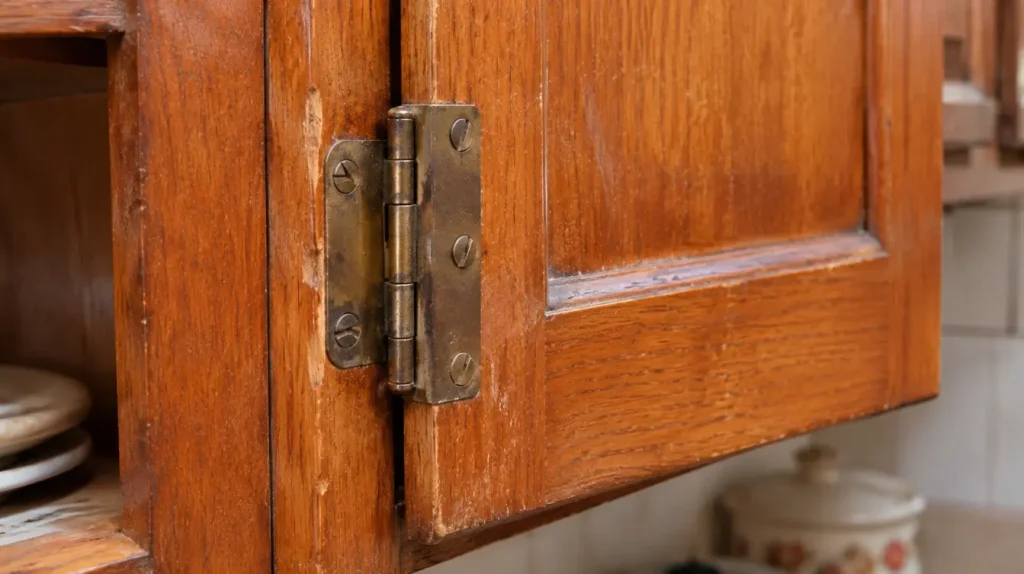
Most cabinet doors are supported by hinges attached to the cabinet box or face frame. Over time, repeated opening and closing can loosen mounting screws. Heavy doors, worn hinge mechanisms, and damaged screw holes can also affect alignment.
In older kitchens, repeated painting or previous hardware replacements may leave multiple screw holes around the hinge area. If the screws no longer grip solid material, tightening them may provide only temporary improvement.
Warning signs homeowners should notice
- The top or bottom of one door sits lower than the neighboring door.
- The door rubs against the cabinet frame during opening or closing.
- The hinge moves when the door is operated.
- The mounting screws repeatedly loosen.
- The door remains partially open after being released.
How to inspect and repair the problem
Start by checking whether the hinges are loose or visibly damaged. Many modern concealed hinges have adjustment screws that control side-to-side, depth, and vertical alignment. Adjust these gradually rather than turning one screw excessively.
If a screw spins without tightening, the mounting hole may be stripped. Depending on the cabinet construction and damage, the hole can sometimes be repaired using an appropriate wood repair method or a compatible replacement fastener. Severely damaged mounting areas may require a reinforcement plate or replacement of the affected cabinet component.
For older exposed hinges, check whether the hinge leaf is bent, the screws are corroded, or the door itself has become distorted.
Repair or replace? If the cabinet box is solid and the problem is limited to hinges or screw holes, repair is generally preferable. Replacing an entire cabinet because of a loose hinge is rarely justified.
2. Sticking Drawers and Broken Drawer Slides
Kitchen drawers carry cookware, utensils, food containers, and other heavy items. After years of use, their slides can wear out, wooden runners can become damaged, or the drawer box can lose its original alignment.
Common causes
Older cabinets may use simple wooden runners, roller slides, or metal side-mounted slides. Each design has different wear points.
- Wooden runners may wear down or swell when exposed to moisture.
- Metal slides can accumulate dirt, lose lubrication, or develop worn rollers.
- Loose mounting screws can allow the slides to shift out of alignment.
- Overloaded drawers can bend slides or weaken the drawer bottom.
- A distorted cabinet box can prevent the slides from remaining parallel.
How to identify the problem
Remove the drawer if the slide design allows it, then inspect the runners, mounting screws, drawer bottom, and side panels. Check whether the drawer is level and whether the slides move smoothly without excessive looseness.
If the drawer opens normally when empty but becomes difficult to move when loaded, the slides may be worn, under-rated for the load, or improperly installed.
Repair options
For older wood-on-wood runners, minor surface wear may be corrected by repairing damaged contact areas and using an appropriate lubricant designed for the material. Avoid excessive oil because it can attract dust and debris.
For metal slides, replacing the complete slide pair is often more reliable than attempting to repair bent or badly worn components. Measure the existing slides, check the available cabinet depth, and confirm the mounting type before purchasing replacements.
A broken drawer bottom may also require a new panel. If the drawer sides and joints remain sound, replacing the bottom can be more economical than buying a completely new cabinet.
Repair or replace? Replace the slides or damaged drawer components when the cabinet box remains square and stable. If the cabinet itself is swollen or distorted, correcting the cabinet structure may be necessary before installing new hardware.
3. Water Damage Under the Kitchen Sink
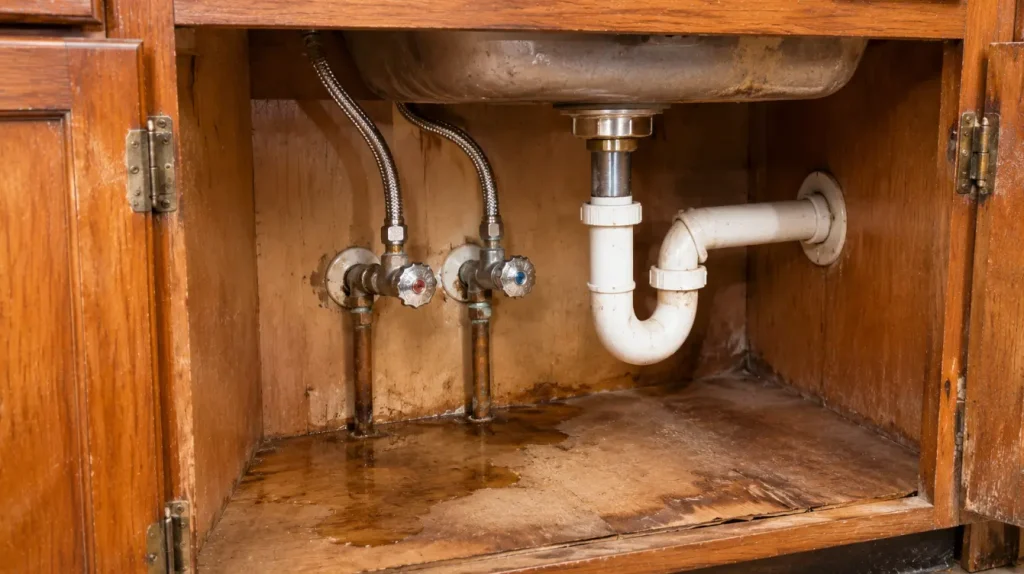
The cabinet beneath the kitchen sink is one of the most vulnerable areas in an older kitchen. It contains drain connections, hot and cold supply lines, shutoff valves, and sometimes a garbage disposal or water filtration system. A small leak can remain unnoticed because the cabinet bottom hides moisture until the material begins to swell or deteriorate.
What causes water damage?
Common sources include:
- Leaking faucet supply connections or shutoff valves.
- Loose or deteriorated sink drain connections.
- Leaking garbage disposal mounting assemblies or drain connections.
- Dishwasher drain hoses or nearby plumbing connections.
- Water splashing from the sink and collecting around plumbing penetrations.
In older homes, previous plumbing repairs may also contribute to the problem. Different generations of fittings, aging metal pipes, and poorly sealed connections can create several potential leak points beneath one sink.
Warning signs of a damaged sink-base cabinet
Look for swollen cabinet flooring, dark water stains, peeling laminate, soft particleboard, loose shelf supports, and a persistent musty odor. A cabinet bottom that feels spongy or crumbles under light pressure may have lost much of its original strength.
Do not assume every swollen cabinet was damaged by a plumbing leak. Water can also enter through an improperly sealed sink rim or from repeated splashing around the countertop. The moisture source must be identified before repair begins.
How to inspect the damage
Remove stored items and carefully inspect the cabinet floor, back panel, side panels, plumbing penetrations, and surrounding connections. Dry the visible surfaces and check which areas become wet again during normal sink use.
Contractors often inspect both the plumbing and the cabinet materials. If the floor below the sink feels soft, they may also assess the subfloor through accessible areas. In homes with an unfinished basement or crawl space, the plumbing and floor assembly below the kitchen may provide additional clues about long-term moisture exposure.
Repair options and cost considerations
For limited damage, a cabinet bottom or removable shelf may be replaced while retaining the original cabinet box. Some sink-base cabinets can also be fitted with a replacement bottom panel designed to protect the repaired area.
However, severely swollen particleboard usually cannot return to its original strength simply by drying it. If the cabinet sides, back, or mounting areas have also deteriorated, replacing the affected cabinet box may be more practical.
Localized cabinet-bottom repairs may cost approximately $200–$700 or more, depending on access and materials. Replacing a sink-base cabinet can cost several hundred to more than $1,500 when removal, plumbing coordination, and finish matching are involved.
Professional recommendation: Repair the leak before installing new cabinet material. If the source is an old shutoff valve, supply line, or drain connection, address the plumbing first. Installing a new cabinet around an active leak will only repeat the problem.
4. Warped, Swollen, or Delaminating Cabinet Panels
Cabinet panels can change shape after years of exposure to moisture, heat, or repeated temperature changes. The problem may affect the doors, side panels, shelves, cabinet backs, or decorative veneer.
Why cabinet panels deteriorate
Different cabinet materials react differently to moisture. Solid wood can expand, contract, or warp as humidity changes. Plywood may retain its shape relatively well when properly manufactured, but prolonged water exposure can weaken its adhesive bonds and cause veneer separation. Particleboard and MDF can swell when water reaches their exposed edges or damaged surfaces.
Kitchen locations make a difference. Cabinets near dishwashers, sinks, exterior walls, and cooking appliances may experience more moisture or heat than cabinets in other parts of the kitchen.
Warning signs
- Cabinet doors no longer sit flat.
- Laminate or veneer begins lifting at the edges.
- Cabinet shelves become bowed or swollen.
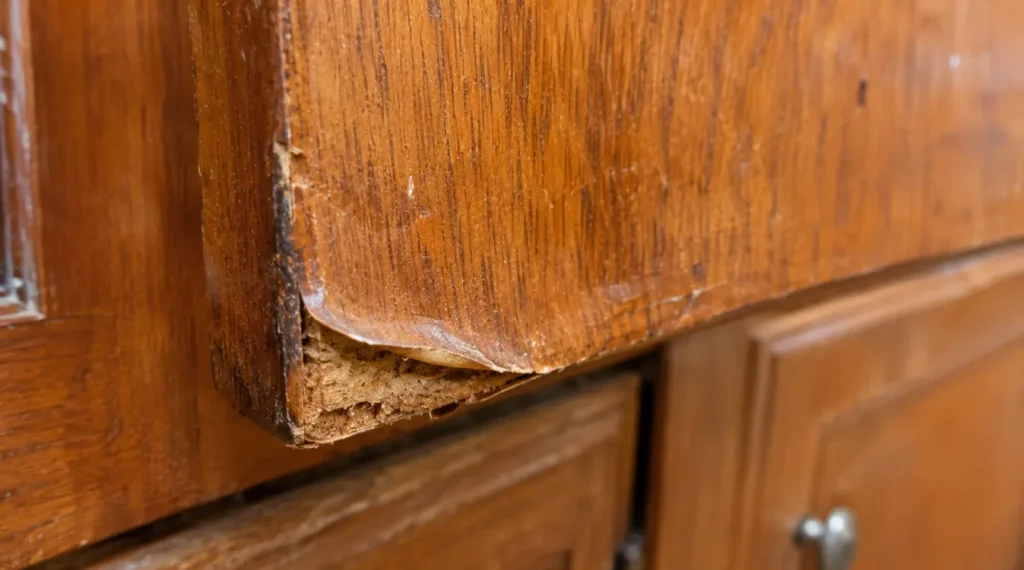
- Panel edges become rough or crumbly.
- Decorative layers separate from the underlying material.
Repair or replacement options
If a solid wood door has minor movement or distortion but remains structurally sound, refinishing or professional adjustment may be possible. A damaged veneer surface may also be repairable when the substrate is stable and the affected area is relatively small.
Particleboard that has significantly swollen or lost its internal strength is more difficult to restore. Painting or applying a new decorative layer over a deteriorated panel will not reliably rebuild the material’s structural integrity.
Replacement is usually more sensible when the panel has extensive swelling, crumbling edges, failed joints, or damage around hinge and mounting points.
5. Peeling Paint, Worn Finishes, and Damaged Veneer
Old kitchen cabinets often show scratches, fading, yellowing, peeling paint, or worn decorative finishes. These issues may make an otherwise functional kitchen look neglected, but surface deterioration does not necessarily mean the entire cabinet needs replacement.
What causes finish problems?
Repeated cleaning, cooking grease, ultraviolet exposure, heat, moisture, and age can gradually damage cabinet finishes. Paint may peel when applied over greasy or poorly prepared surfaces. Veneer can lift when adhesive deteriorates or moisture enters through exposed edges.
In a 1930s or 1940s kitchen, multiple layers of paint may have been applied over original wood cabinets. In later kitchens, laminate or manufactured veneer surfaces may have been installed over older cabinet boxes.
How to evaluate the damage
Check whether the problem is limited to the finish or whether the underlying wood or manufactured panel is also damaged. A stable cabinet door with chipped paint is generally a better candidate for refinishing than a swollen door with loose internal layers.
Before sanding or removing old paint, consider the age of the house. Homes built before 1978 may contain lead-based paint. Suspect coatings should be assessed before disturbing them, especially when large-scale sanding, scraping, or renovation is planned.
Repair options
Depending on the material, options include cleaning and degreasing, repairing small surface defects, sanding appropriate substrates, applying compatible primer, repainting, or replacing the affected veneer or door.
Painting can be a cost-effective way to update sound cabinet boxes and doors. However, paint cannot correct swollen particleboard, loose cabinet joints, or moisture-damaged structural components.
Repair or replace? Refinish the cabinets when the boxes and doors remain stable. Replace individual doors when their surfaces or construction have deteriorated beyond practical repair. Consider full replacement only when damage is widespread or the cabinet layout no longer meets household needs.
6. Loose Cabinet Boxes and Weak Mounting Connections
A cabinet that moves when a door is opened or a drawer is pulled deserves attention. Unlike a loose handle, movement in the entire cabinet box may indicate failed joints, damaged fasteners, or an inadequate connection to the wall.
Common causes
Cabinet boxes can loosen after years of repeated loading, improper original installation, moisture-related material deterioration, or movement in the supporting wall. Upper cabinets are particularly important because they carry dishes, glassware, and other items above work surfaces.
In older kitchens, previous remodeling may have left cabinets attached through old holes or unsuitable fasteners. A wall that has been patched or altered may also provide less reliable mounting support than expected.
How to inspect the cabinet structure
Check the cabinet corners, side panels, back panel, shelves, and visible mounting fasteners. Look for separated joints, cracks around screws, gaps between adjoining cabinets, and movement where the cabinet meets the wall.
Also inspect the surrounding wall for signs of moisture or deterioration. If the cabinet is attached to damaged plaster, weak framing, or a deteriorated wall surface, simply tightening the screws may not correct the underlying problem.
Repair and safety considerations
Small loose joints in a sound cabinet may sometimes be reinforced using suitable fasteners and compatible wood adhesive. Wall-mounted cabinets should be secured to appropriate framing or a verified structural mounting system using fasteners designed for the installation.
Do not rely on ordinary drywall anchors alone to support heavily loaded upper cabinets. If an upper cabinet is pulling away from the wall, unload it and avoid standing beneath it until the mounting has been properly evaluated.
For serious movement, damaged mounting points, or multiple connected cabinets, a qualified cabinet installer or contractor should assess the structure. The repair may involve re-securing the cabinet to framing, reinforcing the box, or replacing a deteriorated unit.
Cabinet Materials: How They Age and When to Repair Them
The material used to build the cabinet box often determines whether a damaged cabinet can be repaired or should be replaced. The cabinet’s age alone does not tell the whole story. Construction quality, moisture exposure, joint condition, and previous repairs are equally important.
| Material | Common Characteristics | Typical Problems | Repair Considerations |
|---|---|---|---|
| Solid wood | Natural wood grain and generally repairable surfaces | Warping, shrinking, cracking, finish deterioration | Often suitable for refinishing and localized wood repairs |
| Plywood | Layered wood construction with good structural potential | Edge swelling, delamination, water damage | Can often be retained if layers and joints remain sound |
| Particleboard | Manufactured wood particles bonded together | Swelling, crumbling, weakened screw holding after moisture exposure | Severely swollen components are usually better replaced |
| MDF | Uniform manufactured fiberboard surface | Edge swelling, softening, finish damage | Suitable for some dry applications but vulnerable to sustained water exposure |
| Laminate or veneer surface | Decorative outer layer over a substrate | Peeling, bubbling, chipped edges | Can be repaired when the underlying cabinet material remains stable |
Well-built wood and plywood cabinets can remain usable for several decades when kept dry and properly maintained. However, there is no guaranteed lifespan for every cabinet because manufacturing quality, installation, household use, and moisture exposure vary widely.
A cabinet with damaged paint but solid construction may have many useful years remaining. A newer particleboard cabinet that has experienced prolonged leakage may need replacement much earlier.
Repair, Reface, or Replace the Cabinets?
Choosing between cabinet repair, refacing, and full replacement depends on the condition of the cabinet boxes, doors, hardware, and kitchen layout. A complete replacement is not automatically the best option, especially when the original cabinets are structurally sound.
Option 1: Repair the existing cabinets
Repair is usually the most economical option when the damage is limited to hinges, drawer slides, handles, loose joints, or small areas of surface deterioration.
It works particularly well when the cabinet boxes are square, the mounting connections are secure, and the material has not suffered extensive moisture damage. Homeowners can also preserve original woodwork that may be difficult to match with modern products.
Option 2: Reface the cabinets
Cabinet refacing involves keeping the existing cabinet boxes while replacing or covering the visible exterior surfaces. Depending on the project, this may include new doors, drawer fronts, veneer, laminate, and hardware.
Refacing is a practical middle ground when the cabinet boxes are sound but the doors and exterior finish look outdated. It can change the appearance of the kitchen without removing every cabinet.
However, refacing does not correct damaged cabinet bottoms, weakened mounting points, deteriorated interior panels, or underlying plumbing leaks. The boxes should be inspected before approving this option.
Option 3: Replace the cabinets completely
Full replacement makes more sense when multiple cabinet boxes have deteriorated, the kitchen layout needs major changes, or widespread moisture damage has affected the structure.
It also provides an opportunity to improve storage, modify appliance clearances, add accessible drawers, and correct poorly designed cabinet arrangements. However, replacement usually involves more demolition, material costs, labor, and potential repairs to walls and flooring.
| Decision Factor | Repair | Refacing | Full Replacement |
|---|---|---|---|
| Existing cabinet boxes | Must be mostly sound | Must be structurally sound | Can be damaged or outdated |
| Appearance improvement | Limited to repaired areas | Major exterior update | Complete appearance change |
| Layout changes | Very limited | Usually limited | Most flexibility |
| Construction disruption | Usually lowest | Moderate | Usually highest |
| Relative cost | Lowest | Intermediate | Highest |
| Best application | Localized damage and functional cabinets | Good boxes with worn doors and finishes | Widespread damage or major redesign |
Professional recommendation: Evaluate the cabinet boxes before deciding on refacing. A new exterior finish may look excellent, but it cannot compensate for a cabinet structure that is already weakened by moisture or failed joints.
Kitchen Cabinet Repair and Replacement Costs
Kitchen cabinet costs vary with the number of cabinets, material type, cabinet dimensions, hardware, finish, installation difficulty, and regional labor rates. Repairing one damaged hinge is very different from replacing several cabinets beneath a kitchen sink or rebuilding an entire kitchen.
| Project | Illustrative U.S. Cost Range | Typical Scope |
|---|---|---|
| Hinge adjustment or replacement | $75–$250 | One or a small number of cabinet doors |
| Drawer slide replacement | $50–$250 per drawer | Hardware replacement and adjustment |
| Minor cabinet wood repair | $150–$600 | Localized joint, panel, or mounting repairs |
| Sink-base cabinet repair | $200–$700+ | Localized bottom or interior panel replacement |
| Cabinet door replacement | $100–$400+ per door | New door with dimensions and finish matched to the existing kitchen |
| Cabinet refacing | $4,000–$12,000+ | New exterior surfaces, doors, drawer fronts, and hardware |
| Full kitchen cabinet replacement | $8,000–$30,000+ | Removal and installation of a new cabinet system |
Cost disclaimer: These are broad illustrative U.S. planning ranges, not verified 2026 national averages or contractor quotations. Kitchen size, cabinet quality, custom dimensions, demolition, countertop removal, plumbing adjustments, and local labor costs can change the final amount substantially. Some estimates include materials and installation, while others charge separately.
When repairing is more economical
If only a few doors, hinges, or drawer slides are damaged, replacement of those individual components may provide good value. Similarly, a solid wood cabinet with a damaged finish may be worth refinishing rather than removing.
When replacement may save money over time
If several cabinet boxes have swollen, joints have failed, and the mounting areas are deteriorating, repeated repairs may become more expensive than replacing the affected units. Compare the total repair scope with the cost of new cabinets, including installation, countertop adjustments, and related work.
Common Homeowner Situations
Scenario 1: A homeowner in a 1940s house has original wooden cabinets
If the cabinet doors are uneven but the boxes remain solid, begin with hinge adjustments, replacement hardware, and inspection of the mounting holes. Original wood cabinets may be worth preserving if their construction remains sound. Refinishing the doors can also improve the kitchen without disturbing the complete cabinet installation.
Scenario 2: A 1950s kitchen has a swollen cabinet beneath the sink
First locate the leak. Check the faucet supply lines, shutoff valves, drain connections, and disposal assembly. If the cabinet bottom is damaged but the side panels and mounting points remain sound, a localized repair may be sufficient. If the particleboard has swollen throughout the cabinet box, replace the affected unit after the plumbing problem has been corrected.
Scenario 3: A 1970s or 1980s kitchen has peeling laminate cabinet doors
Determine whether the damage is limited to the decorative surface or extends into the underlying panel. If the substrate is flat and stable, replacing the doors or using a suitable refinishing approach may be practical. If the panel is swollen or crumbling, new veneer will not restore its strength. Compare individual door replacement with refacing the complete kitchen.
Scenario 4: A homeowner wants to renovate before selling
Focus on visible defects and functional problems. Repair loose doors, sticking drawers, damaged handles, and localized water damage. If most cabinet boxes remain sound, refinishing or refacing may be more appropriate than installing a completely new kitchen. Keep documentation of plumbing repairs and any work involving water-damaged materials.
Which option is best for different homeowners?
- Best for budget-conscious homeowners: Repair hinges, slides, handles, and localized panel damage. Preserve structurally sound cabinet boxes.
- Best for long-term homeowners: Replace deteriorated components, correct moisture problems, and consider a kitchen layout improvement when the existing design limits everyday use.
- Best before selling: Restore normal cabinet function and improve visible finishes without automatically investing in a complete replacement.
- Best for rental properties: Prioritize durable cabinet boxes, readily available hardware, moisture-resistant finishes, and easily replaceable doors and drawer slides.
How to Prevent Future Cabinet Problems
Preventing moisture exposure and maintaining cabinet hardware can significantly extend the useful life of kitchen cabinets. A few routine checks are especially valuable in older homes.
Inspect the sink base regularly
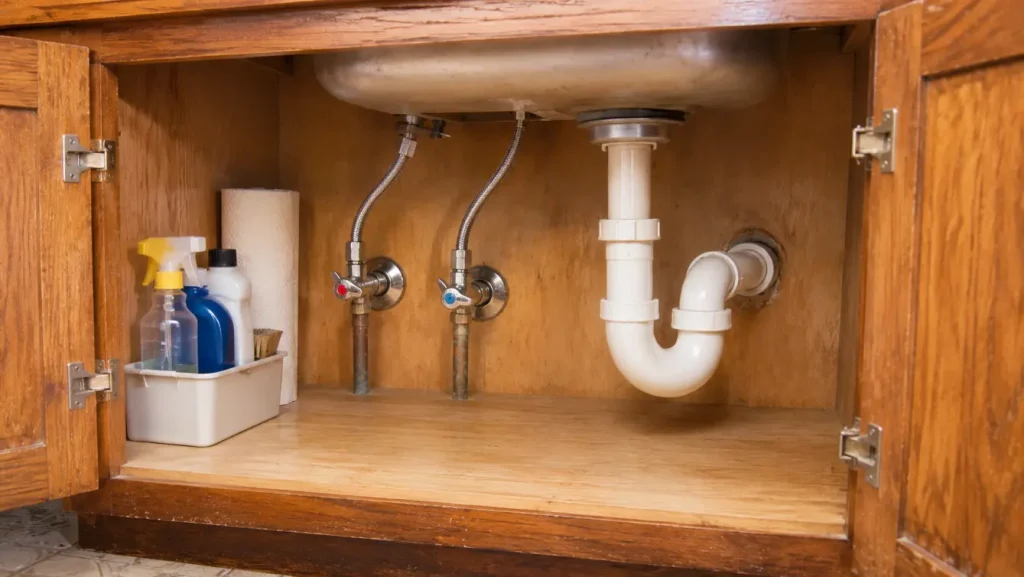
Check the cabinet beneath the kitchen sink for dampness, corrosion, water stains, and loose plumbing connections. Do not store wet cleaning supplies directly against cabinet panels. A small leak should be repaired before the material begins swelling.
Check dishwasher and refrigerator connections
Inspect the dishwasher drain hose and water supply connections, along with the refrigerator’s ice-maker supply line where present. Appliances can leak slowly behind or beside cabinets, allowing moisture to damage hidden panels and flooring.
Maintain cabinet hinges and drawer slides
Periodically check mounting screws and hardware alignment. Clean drawer slides according to their manufacturer’s recommendations and avoid overloading drawers beyond their rated capacity.
Control kitchen humidity and ventilation
Use an appropriate range hood during cooking, particularly when boiling water or producing substantial steam. In humid regions, adequate kitchen ventilation and general indoor moisture control help reduce the risk of repeated condensation.
In older homes with basements or crawl spaces, investigate persistent musty odors or moisture near the kitchen floor. Water entering from below or through an exterior wall can affect cabinet materials even when the plumbing is functioning correctly.
Frequently Asked Questions
How much does it cost to repair kitchen cabinets in an older home?
Minor kitchen cabinet repairs may cost less than $100 in replacement hardware for a DIY project, while professional repairs involving hinges, drawer slides, or localized wood damage may cost approximately $75–$600 or more, depending on the work. Replacing a damaged sink-base cabinet can cost several hundred to more than $1,500 when removal, materials, and installation are included. Costs increase when water damage extends into surrounding cabinets or flooring. Before approving a major replacement, ask a contractor to inspect the cabinet boxes and separate the cost of repairing the structure from replacing doors, hardware, and decorative finishes.
Can water-damaged kitchen cabinets be repaired?
Yes, when the damage is limited and the underlying material remains structurally sound. A solid wood cabinet may be dried and repaired after the moisture source has been corrected, while a damaged plywood panel may sometimes be replaced without removing the entire cabinet. Severely swollen particleboard or MDF is more difficult to restore because the material may have lost its strength. The first step is to stop the leak, assess the cabinet box, and check the nearby subfloor if necessary. Replacing the damaged panel is usually more reliable than covering a deteriorated area with paint or laminate.
How long do kitchen cabinets last in older homes?
Kitchen cabinet lifespan varies widely. Well-built solid wood and plywood cabinets can remain serviceable for several decades, especially when protected from moisture and properly maintained. Manufactured particleboard cabinets may also provide many years of use, but prolonged water exposure can shorten their service life considerably. Hinges, drawer slides, and decorative finishes may need replacement long before the cabinet boxes fail. Instead of deciding based only on the home’s age, inspect the joints, panel condition, mounting points, and moisture history. A 50-year-old cabinet in good condition may be a better repair candidate than a much newer cabinet with extensive water damage.
Should I repair or replace my old kitchen cabinets?
Repair is usually the better choice when the cabinet boxes remain solid and the problems are limited to doors, hinges, drawer slides, handles, or surface finishes. Refacing can make sense when the boxes are structurally sound but the exterior appearance is outdated. Full replacement is more appropriate when multiple cabinet boxes have extensive water damage, deteriorated joints, or unreliable mounting connections, or when the kitchen layout needs major changes. Compare the full repair cost with the installed replacement cost, including countertop adjustments, plumbing work, and related construction. The best decision depends on condition and long-term needs, not age alone.
Final Thoughts
Common kitchen cabinet problems in older homes do not always require a complete kitchen renovation. Sagging doors, sticking drawers, worn hinges, and damaged finishes can often be repaired individually when the cabinet boxes remain structurally sound.
Water damage deserves particular attention, especially beneath kitchen sinks and near dishwashers and refrigerators. Before replacing damaged cabinets, locate and correct the moisture source. Otherwise, even new materials may suffer the same problem.
When considering a larger renovation, inspect the cabinet material, joints, mounting connections, and overall layout. Compare repair, refacing, and full replacement based on the actual condition of the kitchen rather than the appearance of one damaged component.
