
If you own an older home in the United States, there is a good chance you have encountered a plumbing problem that seems to come out of nowhere: rusty water, weak water pressure, a leaking pipe, or a drain that suddenly becomes difficult to use.
Sometimes the real problem is not the faucet, water heat er, or fixture. It is the old galvanized steel piping hidden behind the walls.
Galvanized pipes were widely used in American homes for decades because the steel was coated with zinc to help protect it from corrosion. The problem is that this protective coating does not last forever. As the zinc wears away, the exposed steel can gradually rust from the inside out.
For homeowners renovating an older house, understanding how galvanized pipes deteriorate can help you decide whether a pipe only needs a small repair or whether a larger plumbing replacement project makes more sense.
Quick Conclusion
Galvanized pipes are prone to rust because their protective zinc coating gradually deteriorates, allowing water and oxygen to reach the underlying steel. Once corrosion starts, rust and mineral buildup can narrow the inside of the pipe, reduce water flow, and eventually cause leaks.
A rusty galvanized pipe does not automatically mean that the entire plumbing system must be replaced tomorrow. However, widespread corrosion, consistently low water pressure, rusty-colored water, recurring leaks, or visibly damaged pipes are strong reasons to have the system professionally evaluated.
What Are Galvanized Pipes?
Galvanized plumbing pipe is typically made from steel that has been coated with zinc. The zinc layer was intended to protect the steel from corrosion and extend the useful life of the pipe.
Galvanized steel became common in older residential plumbing systems because it was relatively strong and durable. Many older American houses still have galvanized supply lines, particularly in homes that have not undergone a major plumbing renovation.
One important point for homeowners is that galvanized plumbing can look perfectly solid from the outside while being significantly corroded internally. A pipe may have a relatively normal-looking exterior while its interior opening has become much smaller because of rust and mineral deposits.
Why Do Galvanized Pipes Rust?
The zinc coating provides the first line of protection. Over time, however, the coating can deteriorate due to normal corrosion, water chemistry, mechanical wear, and age.
Once the protective layer is compromised, the steel underneath becomes exposed to water and oxygen. Corrosion can then progress gradually along the inside of the pipe.
This is why galvanized pipe problems are often described as a slow-developing plumbing issue rather than a sudden failure.
- Step 1: The zinc coating provides corrosion protection.
- Step 2: The protective coating gradually deteriorates.
- Step 3: Exposed steel begins to corrode.
- Step 4: Rust and mineral deposits build up inside the pipe.
- Step 5: The internal opening becomes smaller.
- Step 6: Water flow and pressure can decrease.
- Step 7: Corrosion can eventually lead to pinhole leaks or pipe failure.
How Long Do Galvanized Pipes Typically Last?
There is no single expiration date for galvanized plumbing. Actual service life depends on factors such as water chemistry, pipe quality, installation conditions, usage, and maintenance.
In many older homes, galvanized plumbing is now several decades old. Pipes that were installed many decades ago may still be functioning, but age alone is a good reason to inspect them carefully during a renovation.
The key question is not simply “How old are the pipes?” but “What condition are the pipes in today?”
A 60-year-old system with good water flow and minimal corrosion may behave differently from a similarly aged system suffering from severe internal buildup and repeated leaks.
5 Warning Signs of Rusting Galvanized Pipes
1. Rusty or Discolored Water
Brown, yellow, or rusty-looking water can be a warning sign of corrosion inside an aging plumbing system.
If discoloration appears mainly after the water has been sitting in the pipes overnight or for several hours, the condition of the home’s plumbing should be investigated.
However, rusty water does not always mean the entire plumbing system is failing. Water heaters, municipal water work, or other plumbing components can also contribute to discoloration.
2. Low Water Pressure
One of the most common practical problems with aging galvanized supply pipes is reduced water flow.
As corrosion and mineral deposits accumulate inside the pipe, the passage available for water can become significantly narrower. The result may be weak flow at sinks, showers, or other fixtures.
If several fixtures throughout the house have poor pressure at the same time, the problem is more likely to involve the home’s plumbing system than one individual faucet.
3. Frequent Leaks
Older galvanized pipes can eventually develop weak areas and pinhole leaks. A small leak may begin as an occasional drip before becoming a more serious water-damage problem.
When leaks repeatedly occur in different sections of an old galvanized system, replacing only the failed section may become less attractive than planning a larger repiping project.
4. Visible Rust or Corrosion
Check exposed pipes in unfinished basements, utility rooms, crawl spaces, and mechanical areas.
Heavy rust, flaking metal, corrosion around threaded connections, or damp areas around fittings are signs that the plumbing deserves closer attention.
Do not aggressively scrape or disturb heavily corroded pipe just to make it look cleaner. A severely weakened pipe can be more fragile than it appears.
5. Different Water Pressure From Fixture to Fixture
If one bathroom has noticeably weaker water flow than another, localized pipe restriction may be involved.
This is particularly useful information during troubleshooting. Instead of immediately replacing the faucet, a plumber can compare flow at several fixtures to determine whether the restriction is local or part of the larger supply system.
For homeowners renovating an older house, understanding how galvanized pipes deteriorate can help you decide whether a pipe only needs a small repair or whether a larger plumbing replacement project makes more sense.
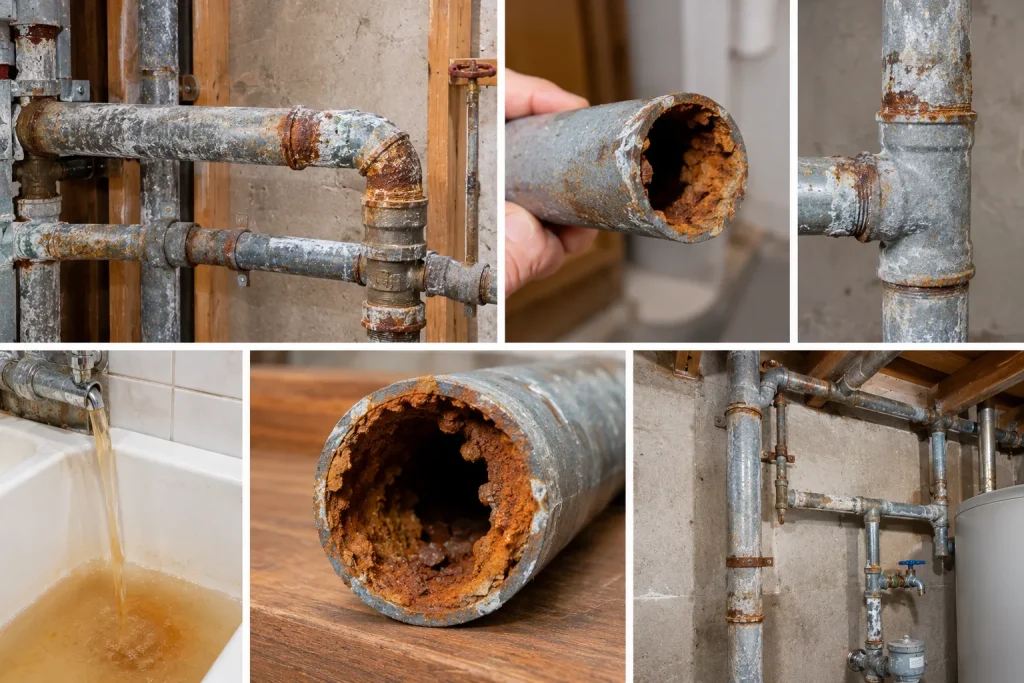
What Happens Inside an Old Galvanized Pipe?
The inside of an aging galvanized pipe can look very different from the outside.
Imagine a steel pipe that originally had a relatively open interior. After decades of exposure to water, corrosion products and mineral deposits can gradually accumulate along the inner wall.
The opening available for water becomes smaller. This restriction can be especially noticeable when several fixtures are being used at the same time.
For example, an older home might have acceptable flow when only the kitchen sink is running. Turn on a shower at the same time, however, and the homeowner may suddenly notice a substantial drop in flow.
That kind of real-world symptom can be more useful than simply looking at the outside of the pipe.
Galvanized Pipe vs. Modern PEX and Copper
| Plumbing Material | Typical Installation | Maintenance | Advantages | Potential Drawbacks |
|---|---|---|---|---|
| Galvanized Steel | Threaded fittings; common in older homes | Increasing attention as the system ages | Strong and historically durable | Internal corrosion, restricted flow, difficult repairs on heavily corroded sections |
| PEX | Flexible tubing with modern fittings | Generally low routine maintenance | Flexible, easier to route through many renovations | Must be installed according to applicable requirements and protected from inappropriate exposure |
| Copper | Rigid pipe with soldered or approved mechanical connections | Generally low routine maintenance | Long history of residential use and good durability | Material and labor costs can be higher; installation requires more skill |
Important: Installation cost varies significantly by location, home layout, accessibility, permits, labor rates, wall and ceiling access, and the amount of pipe being replaced. A simple material-price comparison does not tell you the final cost of a repiping project.
Should You Repair or Replace Galvanized Pipes?
This is one of the most important decisions for an old-house owner.
If one accessible connection is leaking while the rest of the system is performing well, a localized repair may be reasonable.
If the home has multiple leaking sections, severe corrosion, poor water flow, or extensive internal buildup, a whole-house repiping project may be more practical.
| Condition | Possible Approach | Why |
|---|---|---|
| One accessible leak | Localized repair | May be appropriate when the rest of the system is in good condition |
| Visible corrosion at several locations | Professional inspection and replacement planning | May indicate system-wide aging |
| Low flow throughout the house | Investigate supply piping | Internal restriction may be widespread |
| Repeated leaks | Consider repiping | Repairing one leak may not address the underlying deterioration |
| Major whole-house renovation | Evaluate replacement before closing walls | Open walls can provide easier access to plumbing |
A Realistic Old-House Renovation Scenario
Consider a two-story house built several decades ago.
The homeowner notices that the upstairs shower has weak flow. The kitchen faucet also seems slower than it used to be. There is no obvious leak.
Instead of replacing the showerhead immediately, the homeowner checks several fixtures. The kitchen, bathroom sink, and shower all show weaker-than-expected flow.
An inspection then finds aging galvanized supply piping with substantial internal corrosion.
In this situation, replacing the showerhead alone would not solve the underlying problem. The restriction is associated with the old supply piping.
Now consider a different house where one exposed threaded connection in an unfinished basement is leaking, while water pressure is normal and the other pipes appear to be in good condition.
That situation may justify a targeted repair rather than an immediate whole-house repipe.
The lesson is simple: diagnose the plumbing system before choosing the repair.
What About Plumbing Replacement Cost?
Homeowners often search for a single price for replacing galvanized pipes, but there is no reliable nationwide price that applies to every old house.
The final cost can change dramatically depending on several factors:
- Size of the house
- Number of bathrooms and fixtures
- Number of stories
- Basement, crawl-space, or slab foundation
- Accessibility of existing pipes
- Amount of drywall, flooring, or cabinetry that must be opened
- Selected replacement material
- Local labor rates
- Plumbing permits and inspection requirements
- Whether other plumbing components are upgraded at the same time
For this reason, homeowners should compare written estimates based on the actual scope of work rather than choosing a contractor solely because of the lowest advertised price.
What Should You Check Before Buying an Old US Home?
If you are considering purchasing an older house, plumbing deserves the same attention as the roof, electrical system, foundation, and HVAC equipment.
- Find out what type of supply piping is installed.
- Look for exposed galvanized steel in the basement or mechanical areas.
- Check for visible corrosion and leaking connections.
- Test water flow at multiple fixtures.
- Ask about previous plumbing repairs.
- Look for evidence of recurring water damage.
- Determine whether the sewer and drainage systems have also been inspected.
- Ask a qualified home inspector or plumber for professional evaluation when the condition is uncertain.
If you are already planning a major renovation, it is often worth evaluating old plumbing before new walls, cabinets, flooring, or ceilings are installed.
We cover Old House Repair in more detail in our guide to Old House Repair, including what to look for and how to handle common problems.
Can You Replace Galvanized Pipes One Section at a Time?
Yes, in some situations a plumber can replace individual sections. Whether that is a good long-term strategy depends on the condition of the remaining system.
If the rest of the galvanized plumbing is already heavily corroded, replacing one failed section may simply move the homeowner’s attention to the next weak point.
On the other hand, if corrosion is limited and the system is otherwise performing well, targeted repairs can sometimes make financial sense.
This is why the age, condition, accessibility, and performance of the entire system should be considered together.
Frequently Asked Questions
1. Are galvanized pipes dangerous?
Old galvanized pipes are primarily a plumbing-condition concern because corrosion can affect water flow and contribute to leaks. Some older plumbing systems can also contain or be connected to other legacy materials that deserve separate evaluation. If you are concerned about drinking-water quality, have the water tested and have the plumbing system evaluated by an appropriately qualified professional.
2. How can I tell if my house has galvanized pipes?
Look at exposed plumbing in the basement, crawl space, utility room, or other accessible areas. Galvanized steel pipe is typically rigid, metallic, and connected with threaded fittings. However, appearances can be misleading, especially in houses that have had multiple plumbing upgrades. A plumber or home inspector can help identify the materials accurately.
3. Can galvanized pipes be cleaned instead of replaced?
Cleaning may address certain surface or localized issues, but it does not restore steel that has already been lost to corrosion. If the pipe wall is significantly deteriorated or the internal opening is severely restricted, replacement is generally the more durable solution.
4. Should I replace galvanized pipes when remodeling an old house?
If walls, ceilings, floors, or cabinets are already being opened for a major renovation, it is a good time to evaluate aging plumbing. Replacing deteriorated pipes before the finished surfaces are restored can reduce the chance of having to reopen the same areas later.
5. Is PEX better than galvanized pipe for an old-house repipe?
PEX can be an attractive option for many residential repiping projects because it is flexible and can simplify routing through certain homes. Copper remains another established option. The best choice depends on local requirements, installation conditions, budget, water conditions, and the specific design of the house.
Final Thoughts
Galvanized pipes were a practical plumbing solution for many older American homes, but time changes the equation.
The zinc coating gradually loses its protective ability, corrosion develops, and rust and mineral deposits can reduce the internal diameter of the pipe. Eventually, homeowners may notice rusty water, low water pressure, leaks, or other plumbing problems.
The most important takeaway is not that every old galvanized pipe needs immediate replacement. It is that an aging galvanized plumbing system should be evaluated based on its actual condition and performance.
If you are buying an older US home or preparing for a major renovation, checking the plumbing before closing walls or installing new finishes can save significant trouble later. A professional inspection can help you determine whether a simple repair is enough or whether a complete repiping project is the smarter long-term investment.
Meta Description: Why do galvanized pipes rust in old US homes? Learn how corrosion starts, warning signs, repair options, costs, and when replacement makes sense.
